

Listening Guide: ochre song
Ahead of the upcoming New York premiere of ochre song on 17 August 2026 at the TIME:SPANS Festival — courtesy of conductor Rebekah Heller and International Contemporary Ensemble — I thought I would put together this modest listening guide. The work has a dedicated page on my site here, where you can also find a programme note and further details about the work.
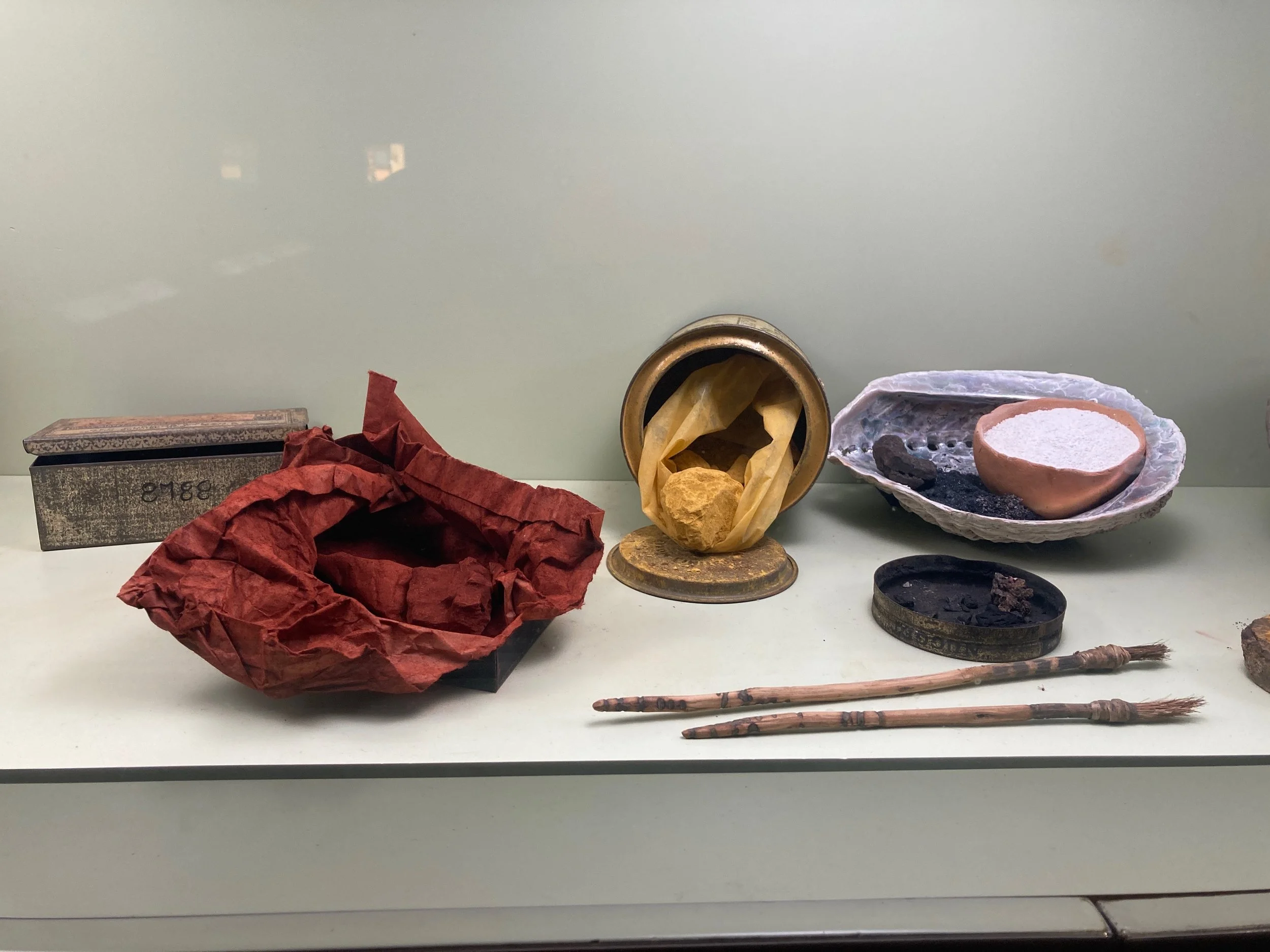
from the Iziko South African Museum | September 2024, Cape Town
What is it about?
ochre song was inspired by the idea of exploring the relationship between physical material and sound material. Thus, the mineral ochre serves as a metaphor for material colour and sound colour. The cultural (and ritual, depending on the cultural context) significance of ochre was also vaguely in the back of my mind whilst composing the work, but here it relates primarily to the more ritualised aspects of my own creative practice. There will be more on that in a longer write-up, later.
Three main categories of sound or texture are utilised here: grain, fluid, and earth. These represent more general categories of sound objects rather than any systematised set of materials. I was thinking about all the different ways one might configure an assemblage of these three categories of material (physical or sound), and how different configurations (in terms of proportion, order and dispersal) could produce ‘scenes’ of varying aesthetic quality.
What might one hear?
The shape of the music
Since I tend to write works with an odd narrative shape, and whose construction and seams are intentionally laid bare before the audience, the form of the work may come across as curiously sculpted. ochre song utilises what I would refer to as a ‘collage corridor’ structure where the temporally linear act of performing and/or listening to the work is juxtaposed with the hyperactive narrative of the collage of vaguely interconnected ‘scenes’. Imagine walking through a corridor where you encounter door-less rooms housing semi-related exhibits which all serve as a variation on a single visual or sonic motif. While the whole work takes this ‘collage corridor’ approach, it may be most apparent in the first ten minutes where the narrative flow pushes and pulls with common elements threading together one gesture or texture to another. What might be treated as individual movements, or miniatures, in another composer’s work, are woven together to form one larger tapestry in my own.
The work’s centrepiece, is a minute-and-a-half-long ‘grain ritual’ where a log drum solo initiates a kind of ceremony from which the rest of the ensemble’s colouring emerges. It marks the beginning of the final six minutes of the work whose structure appears, unlike the earlier music, to be somewhat more formally conventional, as though the music is now enthusiastically (and finally) settling into a singular narrative.
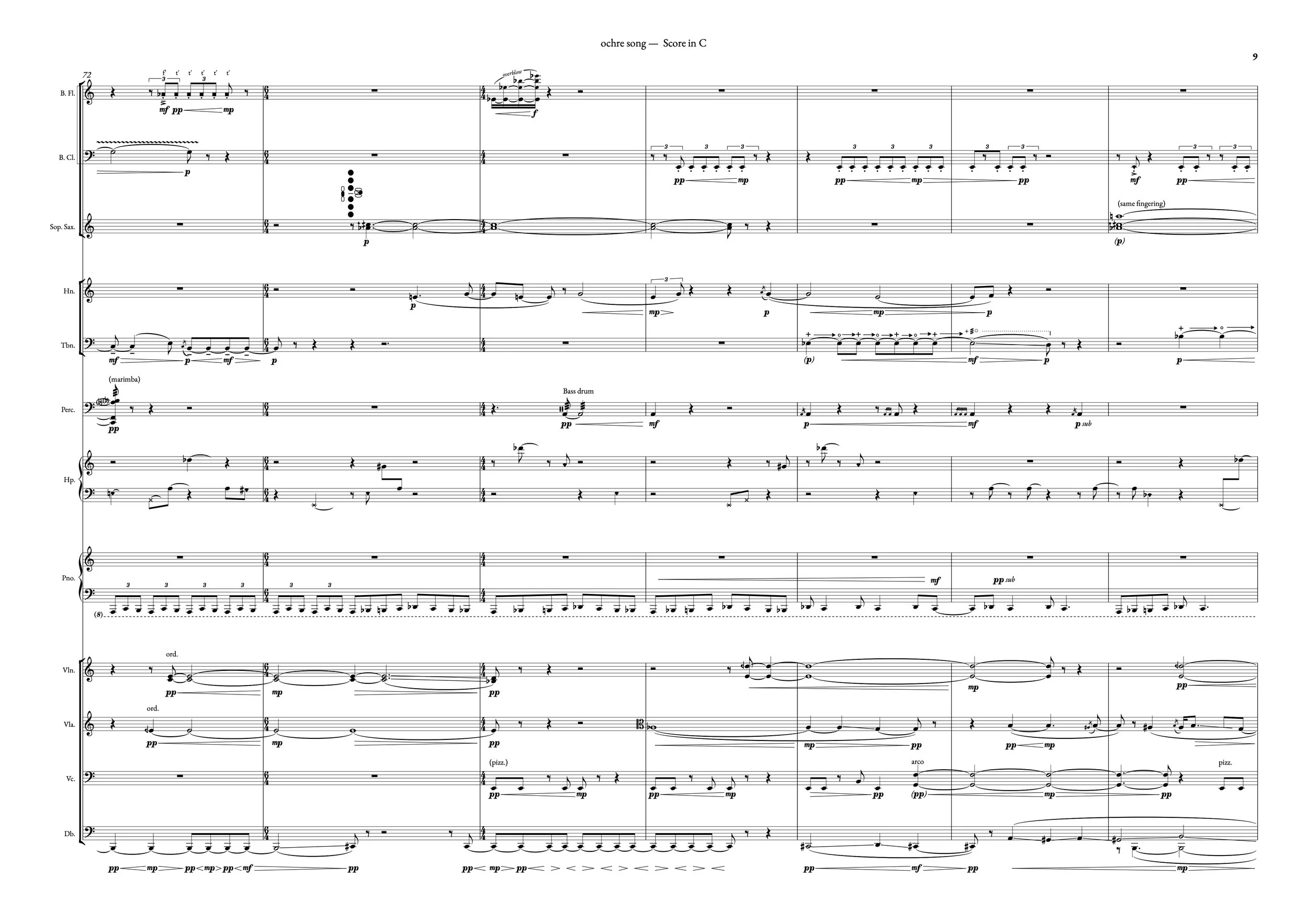
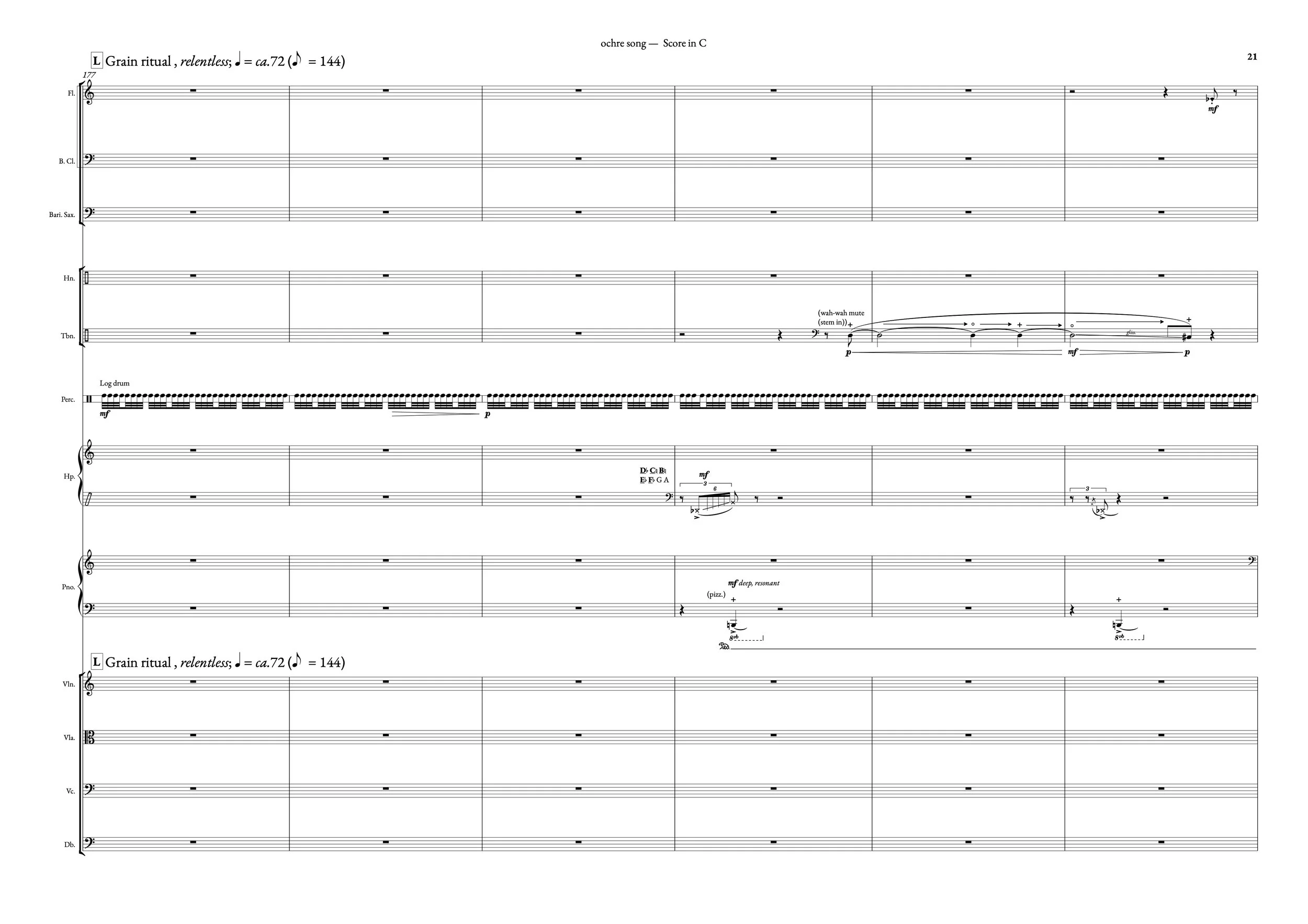
The sound of the music
In ochre song, I incorporate sounds that hint at a very striking physical act; the use of a friction mallet on the bass drum, the biting of the clarinet or saxophone reed to produce violent squeaks, thunderous, low-register glissandi in the harp, waw-wah-muted trombone, earthy double bass glissandi, and the clanging together of glass bottles, amongst other gestures. These sounds both draw attention to their own particular layer within a texture, and also accentuate certain qualities of the overall texture of the ensemble’s sound for any given ‘scene’.
The percussion part, in particular, is a useful thread to follow throughout the work, and I would describe it (and, by extension, the performing percussionist themselves) as a kind of master of ceremonies, which directs the ensemble’s sonic identity at any given moment. It might be good to observe what materials you are hearing at any given moment, say, glass, metal, skin, or plant-based (wood and/or bamboo), and how they relate to the ensemble texture. Liaising with the percussion part, is the harp whose preparations include IKEA-sourced plastic sealing clips as well as paper threaded through some of the strings.
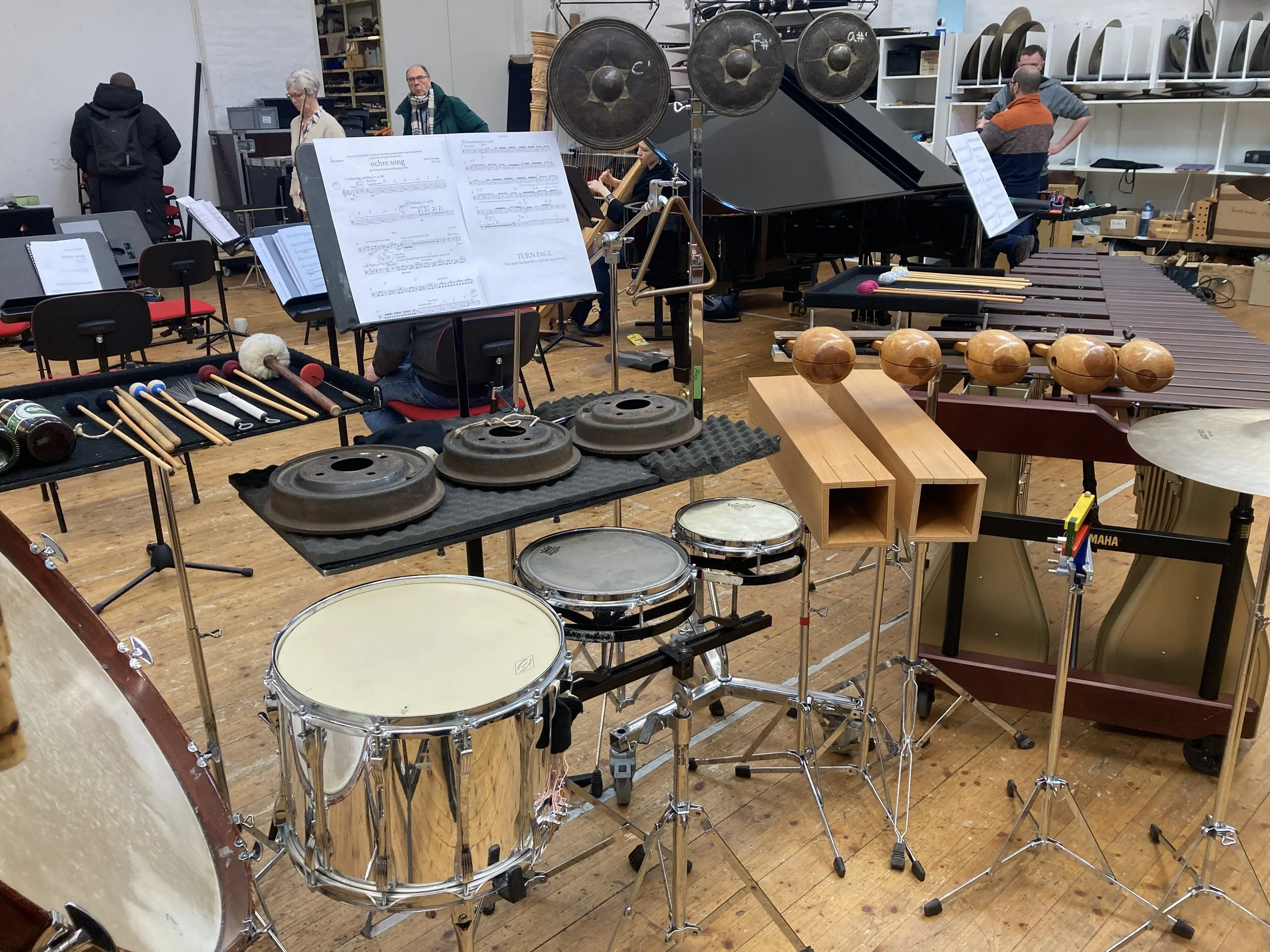
Part of Alex Lipowski’s percussion setup ahead of the work’s world premiere with Klangforum Wien | February 2025, Vienna.
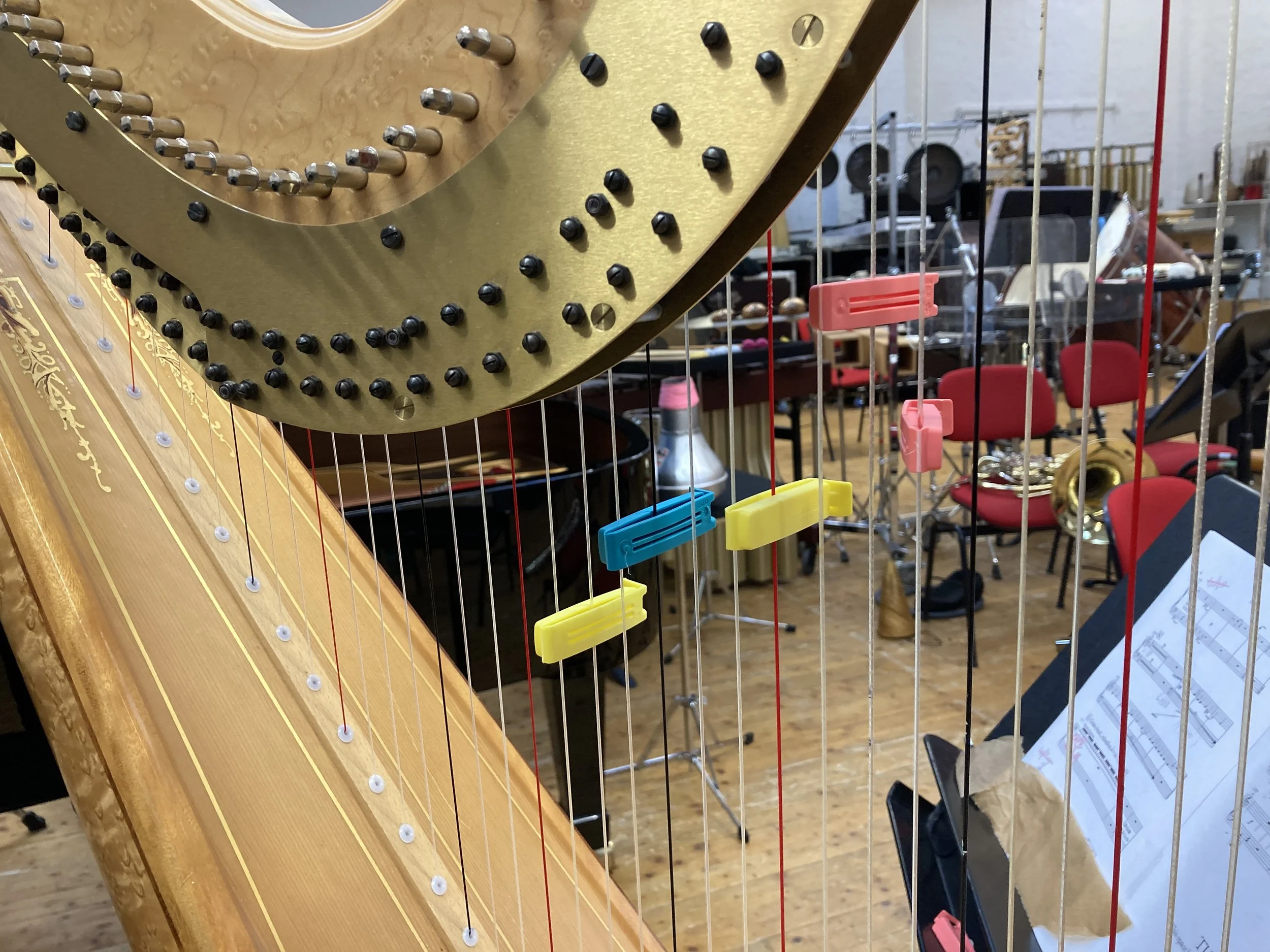
Harpist Tina Žerdin’s suggested sealing clip preparations were a welcome alternative to my original Prestik preparations.
February 2025, Vienna.