

ochre song (2024/25)
instrumentation
12 musicians:
fl(+pic, bass), cl(+bCl), sax(sop+bari), hn, tbn, perc*, hp**, pno, vln, vla, vc, db(5-str)
*1 bamboo chime, bass drum, 3 brake drums, 2 glass bottles, log drum (low, two pitches), marimba (5-octave), 3 tuned gongs, 1 ratchet, 2 roto toms (small, medium), 1 suspended cymbal, 3 temple blocks, 1 tenor drum (low), 1 triangle
**with some removable preparations. See score excerpt for full details
duration
16’00
Commissioned by impuls
world premiere
25 February 2025 | impuls . festival, Helmut List Halle, Graz, Austria | Klangforum Wien. Vimbayi Kaziboni, conductor
NY premiere (final revised version)
17 August 2026 | TIME:SPANS Festival, Mary Flagler Cary Hall, DiMenna Center, NYC, USA | International Contemporary Ensemble. Rebekah Heller, conductor.
Purchase score/performance materials (PDF )
Contact the composer for a perusal recording of this work.
A brief listening guide on the work may be read here.
programme note
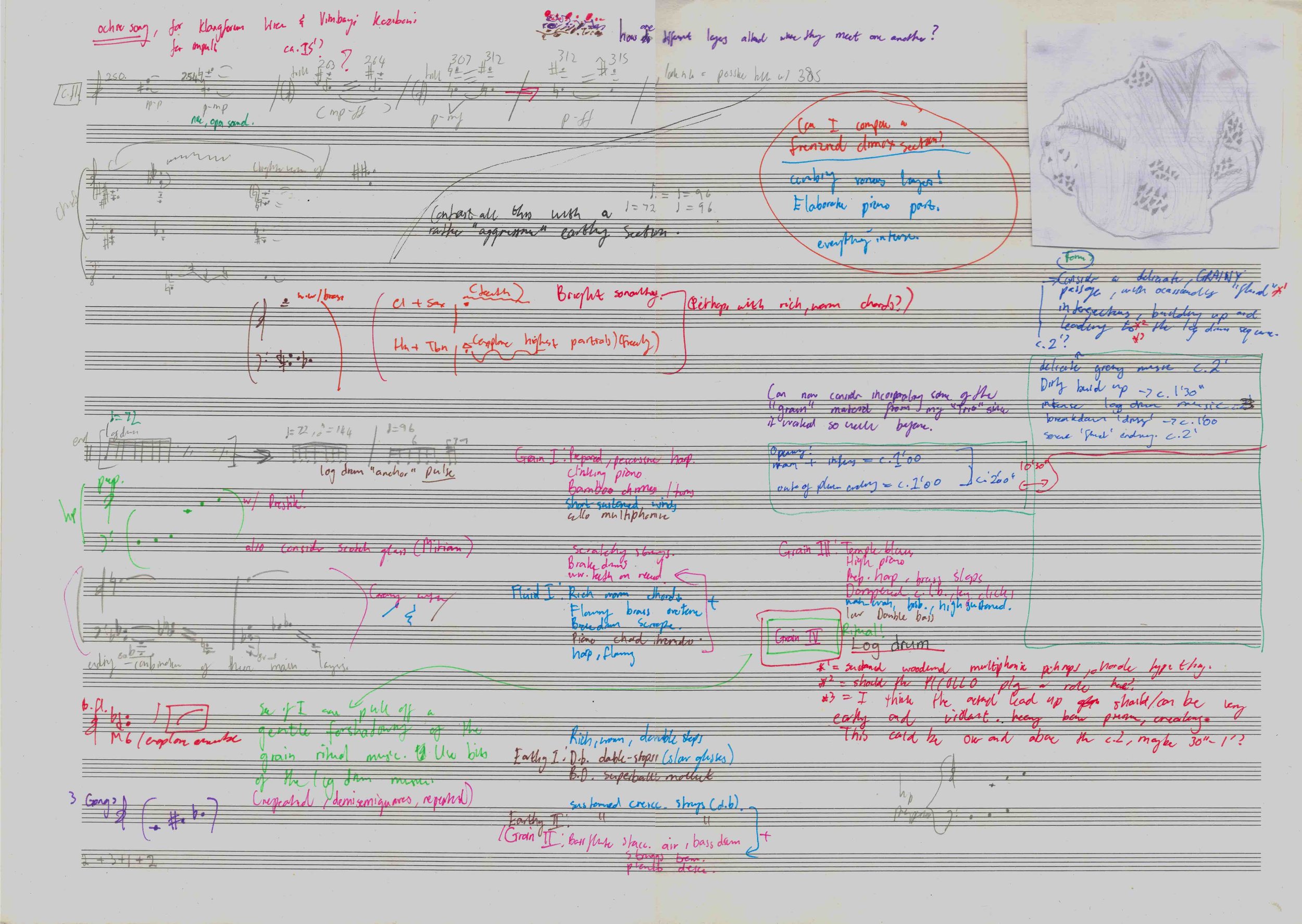
ochre song is an exploration of layers. While the cultural and ceremonial purposes that ochre fulfils are only secondarily alluded to in this work, it is primarily the relationship between the material and pigmentary properties of ochre that serve as a metaphor for the parallels between physical material and sound colour. The work exploits sounds both for their sonic characteristics as well as for the type of materials from which they originate.
The work employs a ‘collage corridor’ form whereby the listener is led through a series of vignettes depicting vaguely interconnected variations on a ‘scene’. In these, I work with primarily three types of sound layers: grain, fluid, and earth, which the listener will encounter in a range of configurations, i.e. the recasting of the vertical order and material ratios of the layers.
The percussion part served as a figurative ‘compère’ during the composition process, where I was especially concerned with establishing a creative ritual whereby the material (both musical and physical) involved in the percussion part would provide direction to the ensemble colouring. The work’s horizontal elements rely heavily on the established associations between gestures and colours across the roughly fifteen different sections that make up the work. For this, I pondered the notion of timbral role-playing. In certain contexts, the marimba, gongs, and prepared harp could be used interchangeably, or the ratchet may behave like a time-compressed and transposed recording of a log drum pattern.
In my music, form can be a fickle beast. Indeed, the use of a Digital Audio Workstation during the composition process allowed me to sculpt the work’s narrative shape, and the software’s track-based infrastructure also served as an appropriate and indispensable tool for my exploratory approach to layers.
— Njabulo Phungula


performance history
25 February 2025 | impuls . festival, Helmut List Halle, Graz, Austria | Klangforum Wien. Vimbayi Kaziboni, conductor
4 December 2025 | Studio 401, Boston Conservatory at Berklee, Boston, MA, USA | contraBAND. Vimbayi Kaziboni, conductor
17 August 2026 | TIME:SPANS Festival, Mary Flagler Cary Hall, DiMenna Center, NYC, USA | International Contemporary Ensemble. Rebekah Heller, conductor.